



Hi everyone! This is a collaboration post by two of us— Tara | Home Sweet Homeschool and Mollie Donghia, both public school teachers turned homeschool moms and we’re so excited to share some thoughts and tips on how we begin a new homeschool year! If you have any other great ideas about how you get started, store supplies, or settle into a smooth rhythm, we’d love to hear in the comments! If you don’t already subscribe to both of us, we’d be delighted to have you following along! Enjoy!
There are so many logistics to consider when starting to homeschool. Some of these decisions are changed over time and as families grow, but we thought it would be helpful to share some of the systems that have worked for us and some other homeschool moms from the Substack community.
Moms who have gone before us are a wonderful resource for learning about homeschooling. I asked my friend Brooke Z what she did to get ready for a new homeschool year and loved her sweet response…
“I love the beginning of a new homeschool year, the smell of crayons, the new notebooks and that cracking sound when you open a new hardback!
Getting back into a routine was always nice too after a relaxed summer.
We started our school year officially after Labor Day in September each year as we took our vacation late in August.
Each year it seemed I moved our materials and supplies around the house as we acquired more. We started out at the kitchen table in the early years with a bookshelf and by the time we ended homeschooling all those years later we had a full room setup and a small library going! It’s what worked for us as well as utilizing the dining room.”
Sharing From Our Experience
Preparing for a new homeschool year looks different for every family. The beauty of Substack and the growing homeschool population is that there are tons of resources we can look to. I have never had a TikTok, but one of my SILs told me she often watches homeschool reels there. What works for one mom may not work for another, but take whatever ideas seem like they would suit your family and forget the rest. 😊
My friend Mollie Donghia and I are here to discuss what we do to prepare for a new homeschool year.
Tara- Hi! I am Tara from Tara | Home Sweet Homeschool and I live in South Carolina with my husband and our 4 kids. This year I will have a 3rd grader, a 1st grader, a kindergartener, and a three-year-old “preschooler” and this is our 4th year homeschooling. I was a public school teacher before becoming a mom and always thought I would go back to teaching once my kids were in school. I never intended to homeschool, I even thought it was “weird” and now I cannot imagine our life any other way. Every year I have learned and adapted. That is the beauty of homeschooling, you can change it based on your family’s individual needs in the season you are in.
Mollie – Hi, I’m Mollie Donghia from This Evergreen Homeschool and I live in Pennsylvania with my husband and our 5 kids! This school year will be our 7th year as a homeschooling family, and although there have been days when it has seemed overwhelming, it’s been such a blessing to our family.
This year my kids will enter grades 5th, 3rd, 1st, and preschool, and my youngest is 4 months old. I unexpectedly decided to homeschool (shortly after resigning my from elementary teaching position) after my oldest daughter, age 3 at the time, asked me to homeschool her. After much prayer, it’s a decision that’s brought a lot of joy to our lives– the flexibility with our schedule, the ability to choose what we teach our kids, and the opportunity to shape who they’re becoming by spending many more hours of their lives together.
How and When Do You Start a New School Year?
Tara: There are so many different models. As a former public-school teacher, I desire having a big chunk off during the summer (where we focus on reading, adventures, and a little math on Math Mondays). I love to start mid-July and finish usually mid-May. Since I am from New York, my husband is from Ohio, and we live in South Carolina – visiting family and having family visit us is super important to me. I find that, by starting early, I am able to take off whenever family decides to visit. We take off any time my mom visits for a week, we go to NY or OH, and a traditional Thanksgiving, a long chunk off for Christmas, and then we usually take off in the spring based on when the family is visiting.
Mollie: Also as a former public school teacher, I love the idea of longer breaks over the summer to leave room for trips, adventures, and lazy days that the rest of the year don’t have as much of. For us, we like to begin our school year by late July so that we’re wrapping up our year by Mother’s Day (honestly it’s such a good gift I can give myself!). We take smaller breaks throughout the school year at holidays and leave space for the occasional day off here and there.
One of the best perks of homeschooling (and having a husband who works from home) is that we can travel anytime we like! Our favorite thing is to do a 2-week trip to Florida in January when the PA weather is unpleasant and we need some sunshine! We still do school, just in another location.


How Do You Store Books, Student Work, and Portfolio Documents?
Storing Books:
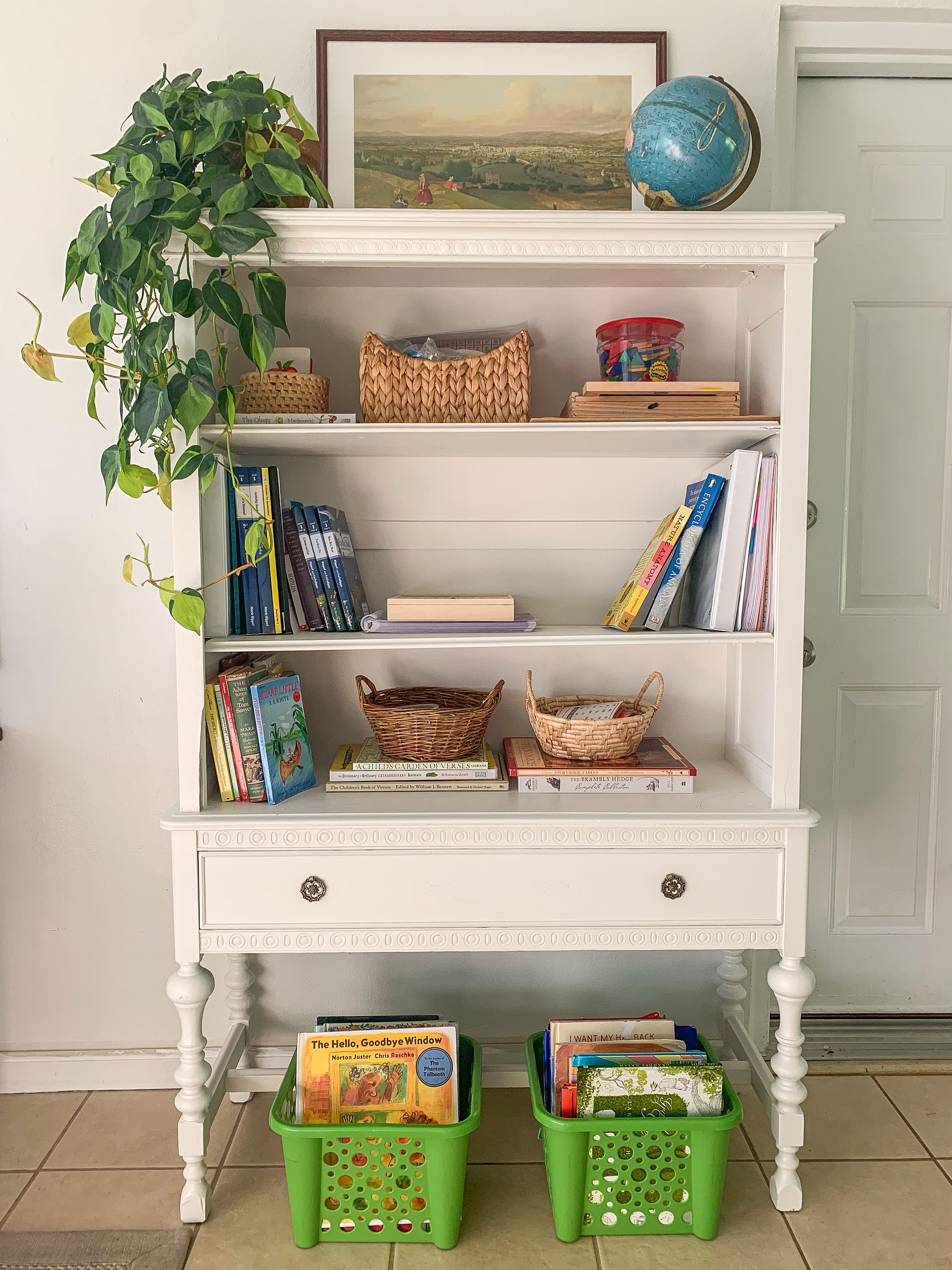
Tara: My husband is an excellent wood-worker (as a hobby, I wish it could be his full-time job!), but it is such a wonderful perk to being married to him. As soon as I realized how many books we would be accumulating, I asked him to build me a new bookshelf for them. We keep it in our room. Having a bookshelf that is for all of the homeschool books has been very helpful to me. If your bookshelf is in a common living space, you could always designate the top shelves to the homeschool books. It helps keep everything in one place and then you know exactly where specific books are. This is also where I keep my past lesson plan books
Additionally, we keep a basket in our living room for library books so those are not mixed up with our books. During specific times of the year, we avoid the library and those baskets are full of our seasonal book collection, which keeps the novelty alive as well. They are also conveniently next to two little brown chairs in a corner that I lovingly refer to “the calm-down corner.” Sometimes little ones need to just sit & relax with a good book and this inviting spot is perfect for that.
I have a “teacher” basket that I keep all of the books for that week in and I update it regularly as we rotate through books. When it is time to do school, I just bring my basket over to wherever we are working that day.
Mollie: I’m a minimalist at heart so anything that isn’t useful isn’t kept! I only hang onto the best books that we’ll come back to over and over again. We also rely heavily on our local library. We have many of our hardcover books in our school room in a cubby where my kids can pull them whenever they have a free moment (these are our science related books, our favorite storybooks, and other non-fiction resources that are frequently used and enjoyed).
I also like to display some of the read-aloud books that we do in History (we use Beautiful Feet Books), and we always have a basket of good read-alouds from the library in our living room for easy access. Keeping books within arms reach has always been one of the best ways that my kids have developed an appreciation for good books.
Storing Completed Work:
Tara: I save all of my children’s consumable books, like ELA (The Good & The Beautiful), Math (Math-U-See), and Handwriting (Handwriting Without Tears). I keep them in my closet in a bin near their portfolios. I just want to keep these items safe just in case I ever need to present them to anyone. I don’t know how long I should keep them, but it feels like protection over my homeschool for some reason – proof of all we have done over the last several years. I wish we had a basement to store stuff in! The Lowcountry is below sea-level so basements are not a thing here!
Mollie: I save my kid’s consumable curriculum books for the next year after they complete them as a way to show evidence if I’d need to show our local school district. I just store them in a crate in our basement and toss them out the following year to avoid cluttering up our school storage space. A few of my kids do curriculums that are online (my son does Beast Academy for math) so it’s all digital and records can be obtained online.
Storing Portfolio Documents:
Tara: I have a box with a lid with folders in it. Each child has a folder for each grade. I keep special work here and work that I feel is worth saving. It is also important to have this depending on where you live, in case your state ever questions you. We do not have to submit anything unless it is asked for, but we must have samples of student work, a portfolio, a lesson plan book, and two report cards per school year for each child. I also have to be a member of a Homeschool Association. Thankfully, my children do not have to deal with standardized testing. Every state is different, but in SC that is how it works.
Mollie: PA has pretty strict homeschool laws, but fortunately since I have my K-6 Elementary teaching degree I am considered a Private Tutor and do not have to have anyone evaluate my kids at the end of the year…which means I don’t need to make a portfolio either. I don’t need to report grades, give a report card, or submit lesson plans– so I feel pretty fortunate but also very responsible that my kids are given a quality and thorough education by myself and a role I don’t take lightly.
Do You Have a System of Displaying Student Work?
Tara: When my children make beautiful art, write something lovely, or make a craft at church, we have boards above their homeschool desk to display their work. The boys have one and the girls have one. Once that board gets full, usually those items end up in their portfolio. I usually empty that board of our summer crafts for a fresh start at the beginning of the year. Emptying the board symbolizes a fresh start and a new school year.
Mollie: A few years ago when the artwork began piling up, I knew I needed to make a permanent space for the items we wanted to display– otherwise they ended up living in piles and collecting clutter (again, I’m a minimalist!). My husband bought two foam insulation boards (you can find them at Lowes or Home Depot), I covered them with white fabric, and then we used command strips to attach them to our school room wall. Each board is about 8x4 feet. We’re able to tack up our favorite art pieces from co-op, special drawings, or anything we want to save for the next few months. I clear off the board every few months and we keep the pieces we want to save and recycle the rest!
What Supplies Do You Purchase?
Tara: As we prepare for the new school year, there are a few items I like to buy every year. New pencils, a new folder for each child, crayons, and markers. Most other items we just buy throughout the year on an as-needed basis. We re-use a binder each year for science with the new curriculum (Sonlight) and then I just store the previous year’s in a folder with the other student work.
Some years, we go as a family and let the kids pick out all of their supplies which has been fun; however, this year, I wanted to be prepared ahead of time. You better believe they all noticed the pile of supplies and have asked multiple times to use them. I gently remind them that they have to wait until the first day. That keeps the excitement alive.
Mollie: I always replenish our key school supplies at the start of the year, such as pencils and erasers, markers, dry erase markers, tape, and notecards. Seeing the fresh supplies come in the mail builds their excitement that another year is about to begin!
Both: If you are just starting out…plenty of paper, coloring supplies, traditional glue, gluesticks, a globe, maps, lined paper, pencil sharpener, blank notebooks, folders, notecards, dry erase markers, small whiteboards
Where Do You Do School and Keep all the Supplies?
Tara: One of the wonderful things about homeschooling, is you do not have to sit on a hard chair at a desk all day. My kids do their work anywhere – the dining room table, the island, the couch, the floor, the porch swing. I do think it is important to have a homebase where everything is kept though.
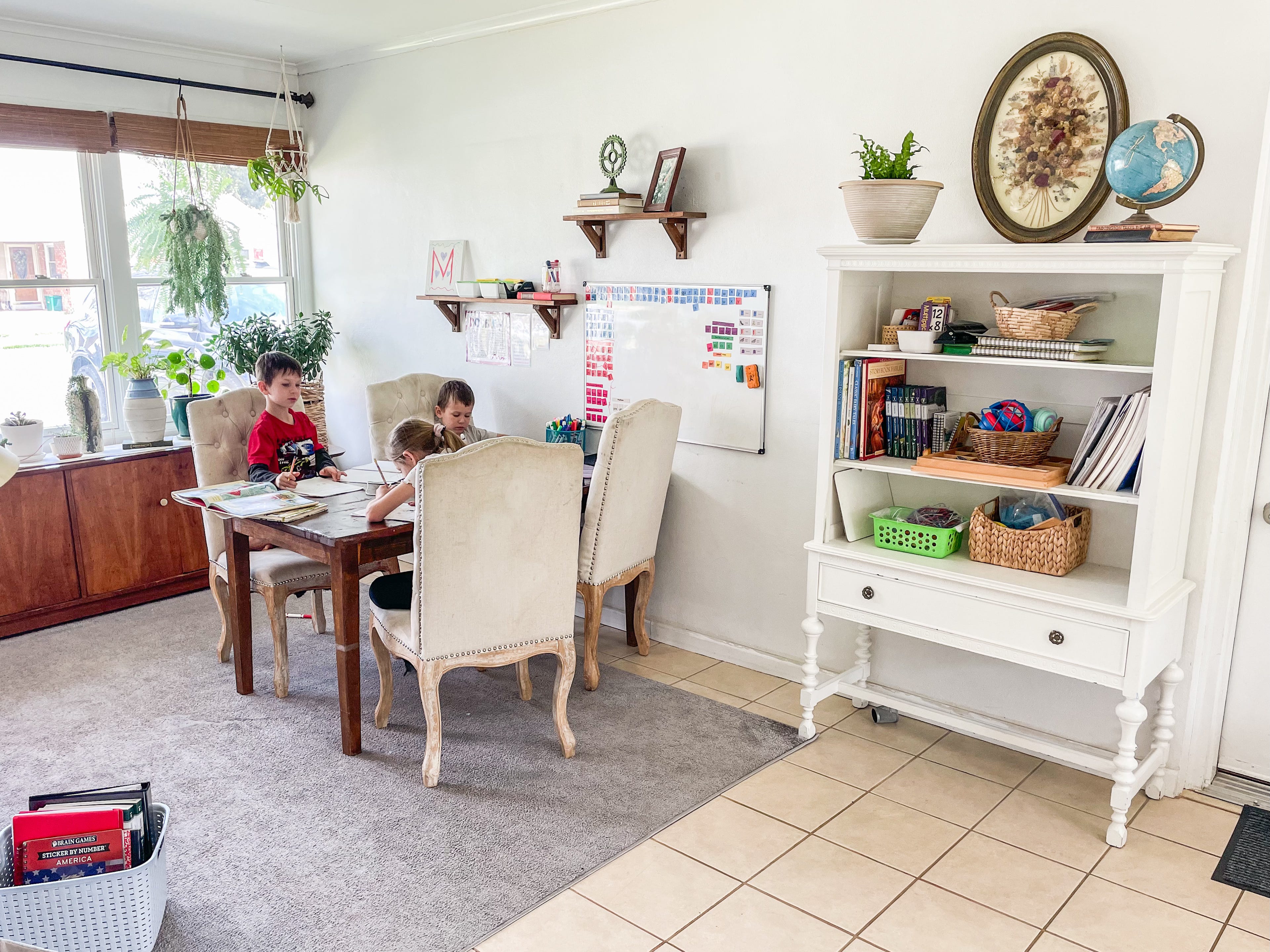
My husband built a cool industrial looking desk out of a huge piece of butcher’s block and metal pipes. It is wide enough for all 4 children (although I wish it could fit 5 now so I could have my own spot, too!). We have a wide hallway in the back of our home and we call it the “Homeschool Hallway.” Each child has a bin at their seat to keep their math, ELA, and folder in. There is also a caddy storing coloring devices, pencils & a sharpener, scissors, and glue.
Like I stated earlier, I keep the books all in my room. I want to keep the excitement alive. Once we have read it together, I let them borrow it. But I try to not allow my children to read ahead or they might be bored during the group reading.
Mollie: When I first began homeschooling, my daughter and I sat at our kitchen table to do schoolwork and did our read-alouds and active work in other places around our house. Today with 4 kids doing school, we need more space for everyone to work. We have a designated schoolroom next to the kitchen (so I can still be productive in-between schooling the kids). Each child has a space at the school table as well as a bin to put all the curriculum and supplies in, which are kept in an 8-cube storage unit.
We store pencils, markers, and dry erase markers in cups on the school table for ease of access and simplicity.
How Do You Plan Field Trips?
Tara: Did you know that your area might have places with homeschool days? This can mean great discounts or even free admission. Three moms and I had pizza and a planning session at my house last week. We mapped out field trips and our “Fun Fridays” for the first half of the school year. It got all of us SO excited for the upcoming school year! I will share more about that soon.
Highly recommend finding other homeschool moms that you vibe with. It enhances the entire experience. Our kids all get along really well and we are all aligned in our faith and values.
Mollie: We’re in three homeschool co-ops (our main co-op that meets weekly, a science/history focused co-op with friends that meets bi-weekly, and a field trip co-op that we can pick and choose which ones to participate in). I try to get my kids out on field trips whenever our schedule allows us to enhance their learning and take adventures together, but it’s definitely not a weekly thing unless it’s summer.
Some of our favorite field trips are hiking with friends, visiting local farms and gardens, touring historic homes, Christmas caroling at the nursing home, going to science and children’s museums, and touring local businesses such as the ice cream store or pretzel factory. We also love the free museum passes from our library which saves us so much money!
What’s Your Homeschool Rhythm?
Tara: Our family thrives having one stay-at-home-day a week. The kids wear pajamas all day and we get a lot of laundry done and the ironing for my husband. I try not to over-plan. More than one commitment a day doesn’t usually bode well with my family.
We start each day with a peaceful morning. The kids are expected to do “the list” before they are allowed down (get dressed, make bed, brush teeth, clothes in laundry basket & this year I am adding read your Bible to it which I am really excited about!!) Then they do the morning chore (unload the dishwasher) and then eat breakfast. We start school around 9:00am. I used to make us start at like 7:00 which is just so unnecessary. This isn’t school at home, it is home school! Now the children enjoy some play time before school and I enjoy a peaceful coffee.
We have mid-day activities a few times a week this upcoming semester so school will have to be completed after those, and we will be participating in Fun Fridays every single week.
This is what our routine will be like this coming school year.
Monday - Stay-at-home-day/Pajama Day
Tuesday - Dance class for 3-year-old @10:15-11:00 *Having big kids bring math or ELA to this.
Wednesday - Art Class for big kids @10:00
Thursday - Homeschool Enrichment classes for all 4 kids @10-10:50 (Weekly coffee date with myself 😊)
Friday - Ice-Skating Lessons for daughter then FUN FRIDAY!
Mollie: I also thrive when we have a daily rhythm and my kids know the expectations of what’s scheduled and what they need to accomplish. Each morning my kids do their chores, fix themselves breakfast, and make sure they’re ready to begin our school day by 9:00. My kids have a laminated schedule that they check off with a dry erase marker to keep them focused and moving along. We have a few weekly activities but otherwise we spend a lot of our mornings at home learning.
Monday - Normal school day (typically school from 9am-2pm with breaks throughout, then afternoon quiet time for everyone)
Tuesday - Normal school day
Wednesday - Our main co-op from 9am-1pm, we do math and independent reading when we get home
Thursday - Bible study for me at our church, my oldest daughter helps with the Kids Ministry, then we do most of our schoolwork when we get home later that morning
Friday - Normal school in the morning, then every other week we have our Science/History co-op from 12pm-2pm
Do You Have Any Special Traditions for the First Day of School?
Tara: We always fill out our First Day of School boards which I love. One of the questions is “When I grow up, I want to be…” I always take a picture of them holding their boards. I love hearing my children’s answers. We also draw self-portraits at some point during the first week. We do it every year so it is fun to watch their art skills improve as they more accurately depict themselves. But I am excited to see Mollie’s answer here because maybe I need to step-up my game for First Day of School traditions.
Mollie: We begin our school year the same way every year…chocolate covered donuts with sprinkles and chocolate milk for a celebration breakfast! It’s such a treat because we rarely have them. I break out our first day of school table decor (a school-themed table runner made by my Grandma years ago) and have their All About Me posters with a new set of colored pencils or markers at each child’s seat. I also write them a special little note too as a way to encourage them and share in the excitement of a new school year together. I also take their pictures too as a way to document this new season of life.
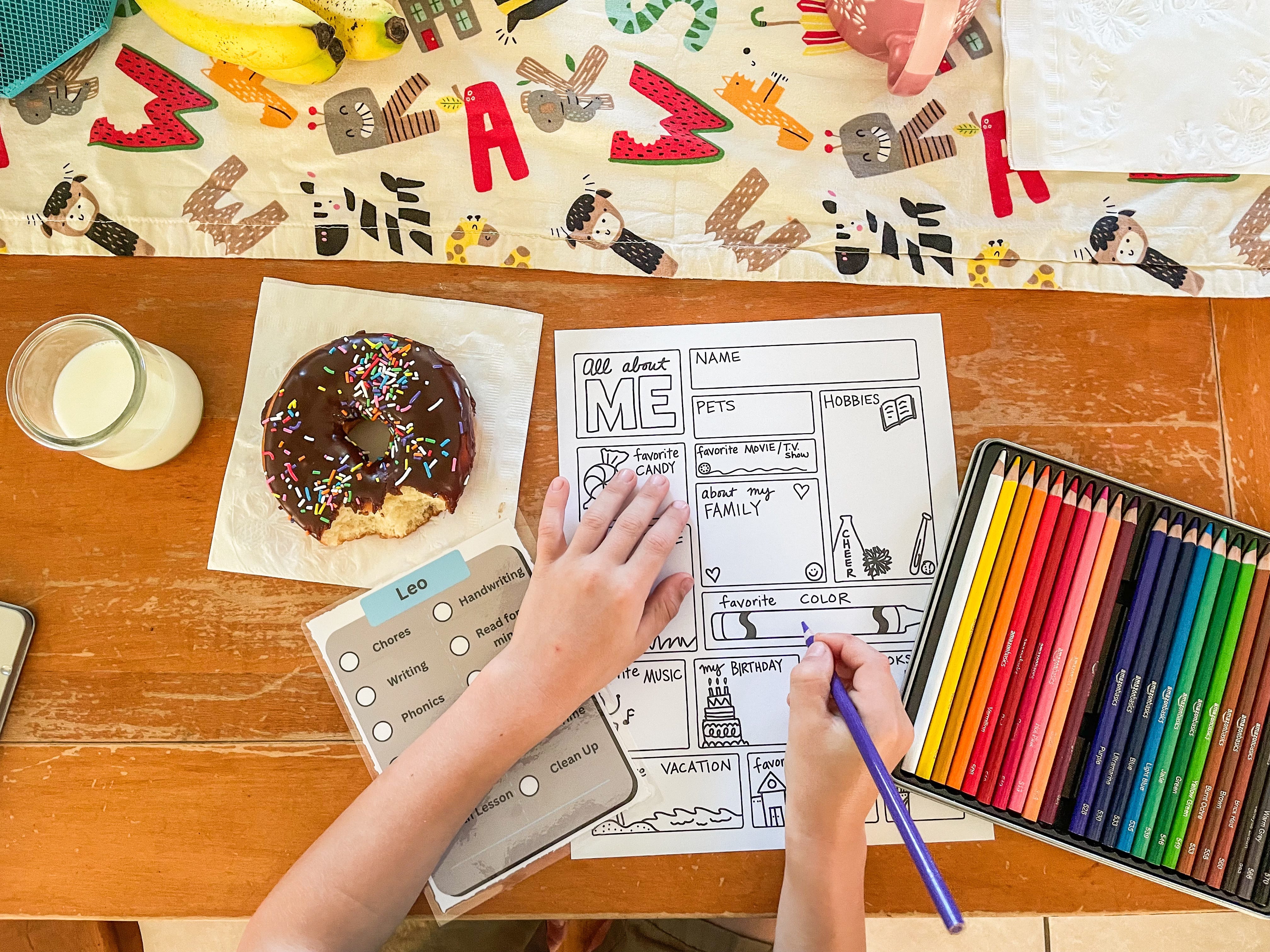
Tara Update: We copied Mollie and had donuts and chocolate milk for breakfast today on our first day! We also did the All About Me sheets over the weekend. I totally forgot about those, I had them do it on the first day of our co-op last year so I was glad this post reminded me of them. The kids were very excited to use the new art supplies. They were so excited about the breakfast idea, I said “Say thank you to my friend Mollie on Substack,” and they all said, “Thank you Miss Mollie!”
Do you Begin Teaching all Subjects at Once?
Tara: I do begin teaching all subjects; however, we start school mid-July, and our homeschool enrichment classes, dance class, baseball, and ice-skating, don’t begin until August or September so it is an inadvertent slow start.
Mollie: Once we begin, I like to introduce one main subject a week as a slow-start to the year– it’s a great way to ease the summer transition! We’ll start math and some smaller items like handwriting or typing the first week, then add in ELA the second week, and additionally science and social studies the next week. By the beginning of September when all the neighbor kids are off to public school, we’re fully into our routine as well. Our two academic co-ops and Bible Study don’t begin until September so it’s a nice way to get into our curriculums before adding on the out-of-the-home activities.
Tara: I am sorry to jump back on, but I just had my first day and Mollie’s idea is fantastic. Today was kind of overwhelming to jump back into all subjects, and to also do the self-portraits and the First Day of School board. I am going to jot this somewhere I will remember it. A slow start takes away any unnecessary stress. Oh and also! Make sure your house and kitchen are clean and tidy before day one. My house was a mess from our family movie day yesterday and I couldn’t function until it was clean which slowed us down a bit!
How Do I Structure the Day to Make Time to Teach all Kids?
Tara: I do as much as we can together first. For example, our Bible reading, poetry, history, and read alouds usually happen first snuggled up on the couch. Science reading is also something that everyone who is in kindergarten or higher participates in. Often my kids all do their math simultaneously and I bop around and help whoever needs help. When I need one-on-one time, I just send the other kids upstairs for some free time. They can play or read or do whatever as long as they aren’t disturbing us. I also find that spending time with the toddler/preschooler/baby before officially beginning school is helpful. And giving them some sort of coloring book or workbook that they can work on and refer to it as their “school.” That helps ensure I can find the time to teach and spend time with each child.
Mollie: This is always a hard one to balance with multiple kids! I create my kid’s daily checklists in such a way that I’m always rotating my focused time between one of my kids. For example, last year I always began working with my kindergartner on his ELA while my other two elementary aged kids began something independently. Then my kindergartner would move onto something independent while I rotated to doing math with my 2nd grader. Then I’d switch to my 4th grader, who required less 1:1 time. They get much more able to work independently the older they get!
We all meet at the kitchen table at 10:00 for a snack and our Morning Basket (Bible and other readings), then continue with more independent work or time 1:1 with me until lunchtime. It’s really just a cycle of rotating through kids and creating enough opportunities for them to do work by themselves so they’re not just waiting around for me!
What Goals Do I Have for Each Child This Year?
Tara: I haven’t really sat down and come up with goals for each child. We always make non-academic summer goals, but haven’t done beginning of the year goals. Other than continuing to improve their spelling, writing, reading fluency, and advancing in math. I would like my children to be more helpful during mealtimes. They are fully capable of serving themselves breakfast, preparing snacks, and even preparing simple lunches. I also am adding to their morning chart for them to read the Bible. That is a life habit that I truly wished someone taught me when I was a child. Another non-academic goal is we are working on their skills with speaking to adults. Looking in someone’s eyes when they are speaking with them and reciprocating questions asked. Things of that nature.
Mollie: My husband and I talk about this a lot as the seasons are always changing with a wide range of ages and abilities of our kids. For our 2 older boys, our current goal is to instill in them the ability to do hard work. We want to raise our boys to be capable of doing hard things (physically and mentally).
I also want my kids’ reading stamina to continue to build, especially my 1st grader as he’s transitioning from non-reader to reader. To help with this we plan time for independent reading with a fun reward system.
For my oldest daughter (soon to be 11), we’re working towards the goal of helping to prepare family dinners each evening– which is one of the best life skills we can teach young kids! She’s my little “sous chef” as she practices chopping, reading a recipe, and growing in her ability to serve our family in this very tangible way. We both love this time of day where we can chat, work together, be creative, and it’s genuinely very helpful for me!
What Do you Do with Little Ones When You’re Trying to Teach Older Kids?
Tara: I actually wrote an article on this topic. But my younger kids are very happy to just go upstairs and play while we are doing school, but I also find that just giving them something to work on alongside us is helpful. Also letting little ones sit on my lap during the read-alouds is helpful. When you have littles that still nap, sometimes it is helpful to do school while they are napping. And if they are too little to be unattended, maybe set up something that will keep them quiet and engaged such as Play-Doh, kinetic sand, stamps, or other toys of that nature. Magnatiles, blocks, and animal figurines keep my children busy for HOURS.
Mollie: This has been the hardest part of homeschooling ever since beginning! During schooltime, I set up toddler friendly activities at our kitchen table– usually playdough, bins of colored rice with scoopers, moon sand, puzzles, a chalk board with magnets, maybe even some water play if I’m feeling up for it! I also let my preschooler do 20 minutes of Reading Eggs on the iPad. Sometimes they’ll sit on my lap and color while I’m working with another child, or play nearby since our play space is the other half of our school room.
How Do You Handle Snacks and Meals Within the School Day?
Tara: My kids eat breakfast before we start, and after reading Mollie’s response I am realizing I should give them the autonomy of fixing themselves a simple breakfast. We always eat snack mid-morning so we all stop for snacks. They usually (over) serve themselves. Then we break for lunch. Sometimes the kids help prepare lunch, but perhaps that will be a goal this year for the two older ones to take turns doing this. An afternoon snack is usually a daily occurrence too. Sometimes I think I shouldn’t let them have 2 snacks, but it is what it is!
Mollie: Part of my older kid’s morning routine is to fix themselves their own breakfast (usually something like a bowl of Cheerios, a sausage pattie, banana, yogurt and granola, a smoothie). I encourage them to eat a bigger breakfast so they’re not hungry in 30 minutes! We then stop at 10am for our Morning Basket and snack time. My rule is one salty snack and a piece of fruit. Around noon we end our schooltime and my soon to be 11-year-old daughter prepares lunch for her siblings (this is a great chore for older kids and very helpful for moms!).
There are so many different ways to find a rhythm in your homeschool. The important thing is you find a way to function as a family providing time for both productivity (both with academics, life skills, and keeping up with the cooking and cleaning) and intentional time together. One of the best parts of homeschooling is the gift of time so being able to enjoy our time with our children is of utmost importance.
Sometimes that means inviting them into whatever it is you’re doing, like Mollie said with cooking dinner with her daughter or getting off the sidelines and joining our kids in whatever they are into – puzzles, board games, art, cooking, whatever it may be.
I (Tara) asked my kids what their hopes are for the new homeschool year and my oldest son wants to play a lot of board games with me, my daughter wants to go on a lot of field trips, and my new kindergartner just wants to have fun. All of these hopes will become their reality. It’s the beauty of homeschooling.
We hope you found this helpful as you prepare for either another school year, a first homeschool year, or if you’re just daydreaming about the future.
Happy Homeschooling!
Tara and Mollie
Such a great post, ladies!!
This is such a wonderful post and thank you so much for writing it! My kiddos are 5 and 3 and this will be our second "official" year homeschooling even though I've dabbled with different things for my daughter since she was 3. It's so helpful to see how other families structure their homeschools and read about things I may not have thought of. Especially the daily/weekly rhythms which has always been the hardest thing for me.
One specific question I have - where did you find the All About Me posters or can you share the download link? I love that idea! I would love to do that at the start of our school year this year. Do you help your littles (toddlers/preschoolers) fill it out too or is it just for your big kids?